Central Heating Pipework Cleaning: A Specialist Guide to System Restoration
- Darrell Willamson
- Jun 6
- 13 min read
Updated: Jun 15
If your radiators stay stone cold at the bottom while your energy bills continue to climb, is your heating system actually working for you, or is it just burning money? You've likely noticed the boiler "kettling" or making odd noises, and no matter how high you turn the thermostat, the house never feels truly warm. It's incredibly frustrating to pay for energy that isn't delivering the comfort your family deserves, especially when you know the system is struggling under the weight of internal corrosion.
We understand that a reliable home is a priority, which is why professional central heating pipework cleaning is essential for total system restoration. By removing the stubborn sludge and magnetite that naturally builds up over time, a specialist can clear the blockages that are currently choking your heat distribution. This process doesn't just fix a temporary symptom; it safeguards your boiler's internal components from premature failure and aligns with the latest water treatment standards.
In this guide, we'll show you how a comprehensive Radiator Power Flush restores full heat to every room and helps to lower your gas bills. You will discover the technical steps a Local Power Flush Company takes to ensure quiet boiler operation and an extended lifespan for your entire system, providing you with long-term peace of mind and a much warmer home.
Key Takeaways
Learn the difference between surface-level radiator maintenance and deep central heating pipework cleaning to ensure your entire system is restored to peak efficiency.
Discover how internal electrolytic corrosion creates sludge traps in your pipes and why these blockages lead to higher energy bills.
Understand the specific scenarios where a professional Radiator Power Flush is the only way to clear stubborn magnetite and protect your boiler.
Identify the early warning signs of system failure using simple diagnostic checks you can perform at home to catch issues before they become emergencies.
Gain insight into how a targeted Power Flush from a local specialist provides a more thorough, long-term solution than a standard chemical rinse.
Table of Contents
What is Central Heating Pipework Cleaning?
Central heating pipework cleaning is the specialized process of purging iron oxide (sludge), lime scale, and installation debris from the internal network of pipes that connects your boiler to your radiators. While many homeowners think of maintenance as just checking the boiler, the pipework acts as the critical infrastructure for heat delivery. If you are wondering What is a Central Heating System? at its core, it's a closed loop of water that relies on clear pathways to move thermal energy efficiently.
Standard water flow from a domestic circulator pump is rarely strong enough to dislodge settled magnetite. Over years of operation, this heavy, black debris settles in low-velocity areas, such as horizontal pipe runs and elbows. A professional Central Heating Power Flush uses high-velocity, low-pressure pumping equipment to create the necessary turbulence to lift these deposits. Unlike a simple chemical rinse, which only treats the water currently in the system, a true Power Flush restores the internal bore of the pipes to their original capacity by physically scouring the internal surfaces.
The Role of Pipework in System Efficiency
Think of your pipes as the "arteries" of your home. In many UK properties, narrow-bore pipework is common. These thin tubes are highly susceptible to blockages because even a small amount of sludge can significantly restrict flow. Modern high-efficiency condensing boilers feature compact heat exchangers with very narrow internal waterways. If the pipework is contaminated, these expensive components become the "filter" for the system, leading to boiler noise (kettling) and eventual failure. Keeping these arteries clean is vital for maintaining the flow rates required by modern heating technology.
Sludge vs. Magnetite: What is Hiding in Your Pipes?
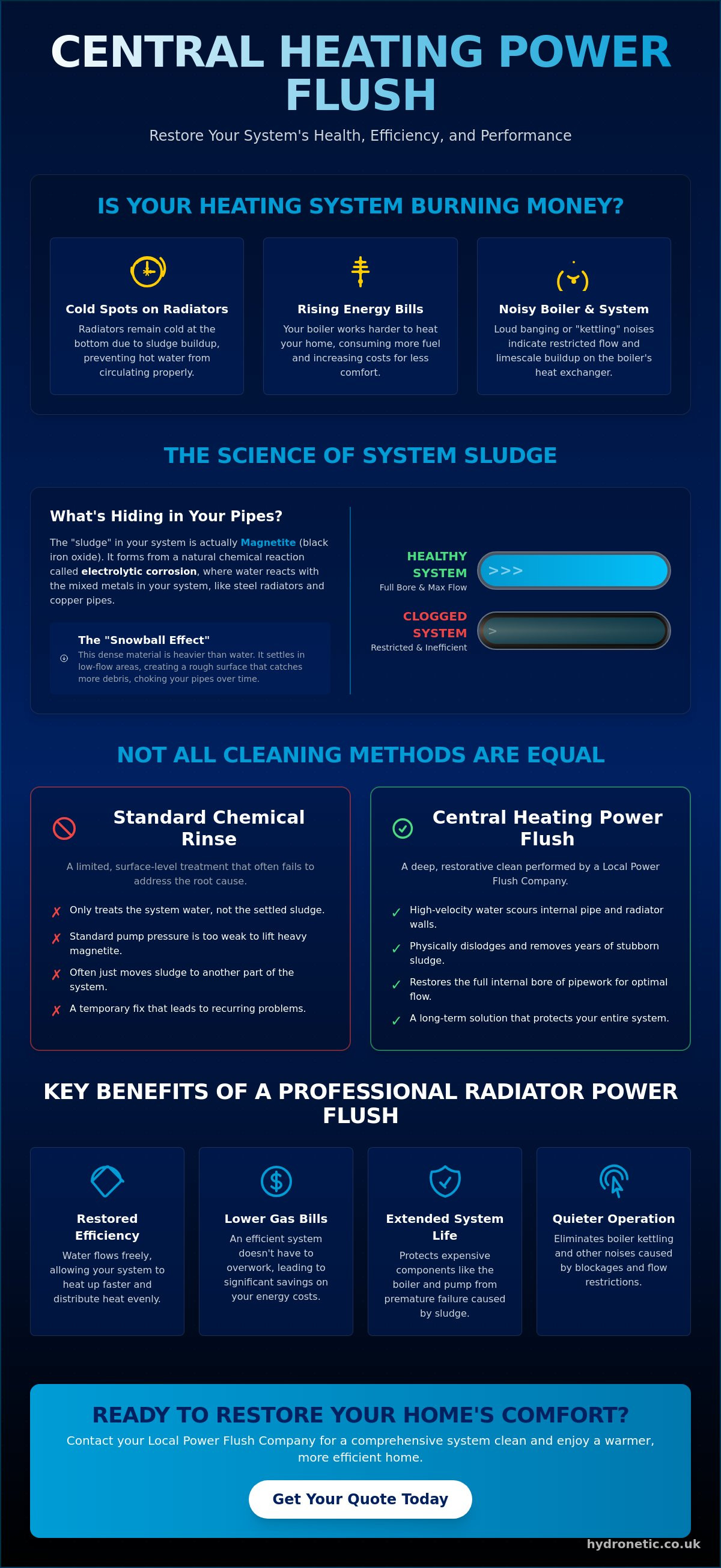
The "sludge" found during a Radiator Power Flush is actually black iron oxide, or magnetite. It forms through a process called electrolytic corrosion, which happens when water reacts with the internal steel surfaces of your radiators. This process accelerates if your corrosion inhibitor levels are diluted or if there's a slow leak introducing fresh, oxygenated water. Magnetite is incredibly dense and magnetic. It doesn't just float; it clings to pipe walls and settles in thick, heavy layers that are difficult to move without specialist intervention from a Local Power Flush Company. Effective central heating pipework cleaning ensures this material is completely evacuated rather than just shifted to another part of the system.
The Science of System Sludge: How Pipework Becomes Blocked
To understand why your heating is failing, you must first understand the chemistry happening inside your walls. Most UK heating systems are "mixed-metal," meaning they contain copper pipework, steel radiators, and brass valves. When water circulates through these different metals, a natural chemical reaction occurs. Without a healthy concentration of chemical inhibitor, this leads to electrolytic corrosion. The result is the formation of black iron oxide, a dense and invasive substance. Exploring The Science of System Sludge reveals that this magnetite is actually heavier than water, causing it to behave more like a liquid metal than simple dirt.
This process creates what engineers call the "snowball effect." As a thin layer of magnetite attaches to the internal walls of your pipes, it creates a rough surface. This increased friction slows down the water velocity, which in turn allows even more debris to settle. Over time, a minor dusting of corrosion transforms into a thick, restrictive layer that chokes the system. Effective central heating pipework cleaning is the only way to break this cycle and restore the internal bore of your pipes to their factory-clean state.
The principle of maintaining clear, efficient circulation is universal across many water-based technologies. Just as central heating requires clean pipes, specialized indoor gardening setups rely on high-quality components to function; you can discover Discount Hydro to explore professional supplies for hydroponic systems.
Identifying "Dead Zones" in Your Pipework
Sludge does not distribute itself evenly. It follows the laws of physics, settling in "dead zones" where water velocity is at its lowest. Long horizontal pipe runs, particularly those tucked away under floorboards, are the most vulnerable. In these sections, gravity pulls the heavy magnetite to the bottom of the pipe, eventually filling half the diameter or more. This restriction forces your circulation pump to work significantly harder, leading to increased energy consumption and premature pump failure. If you suspect your system is struggling, consulting a Local Power Flush Company can help identify these hidden blockages before they cause a total breakdown.
The Impact on Boiler Health
The danger of clogged pipework isn't limited to cold radiators. When magnetite is allowed to travel freely, it eventually reaches the boiler's most sensitive component: the primary heat exchanger. Because these components are designed with incredibly narrow waterways to maximize heat transfer, they act as a trap for debris. This leads to several common issues:
Kettling: Distinguishable whistling or banging noises caused by localized overheating.
Short-cycling: The boiler turns on and off rapidly because it cannot move heat away fast enough.
Total Blockage: Debris becomes so compacted that water flow stops entirely.
If your system has reached this stage, you may require a specialized boiler blockage clearance to prevent permanent damage to the unit. Routine central heating pipework cleaning acts as a preventative shield, ensuring these particles never have the chance to settle in your boiler's internal components.
Comparing Methods: Chemical Flush vs. Central Heating Power Flush
Choosing the right cleaning method is the difference between a temporary fix and a total system restoration. While both approaches use specialized chemicals to break down debris, their effectiveness depends entirely on the current health of your pipework. A standard chemical flush is an excellent preventative measure for newer systems or those that have been well-maintained. It involves adding a cleaning agent to the system water and letting it circulate for several days before draining. However, this method relies on the existing system pump, which often lacks the strength to move heavy, compacted magnetite.
For systems showing signs of distress, a Power Flush is the industry-standard solution. The British Standard for central heating systems (BS 7593:2019) highlights that proper cleaning and filtration are essential for maintaining efficiency and meeting warranty requirements. Unlike a simple drain-down, a professional flush uses a dedicated pump to circulate water at high velocity. It's important to understand that velocity, not pressure, is the key to success. High pressure can damage old joints and lead to leaks, whereas high velocity scours the internal walls of the pipes to dislodge stubborn deposits without putting the system under undue stress.
When a Chemical Flush is Not Enough
If your radiators have significant cold spots or your boiler is frequently locking out, a chemical flush won't be enough. Because a chemical flush is gravity-fed or relies on a weak circulator pump, it follows the path of least resistance. This means the water flows through the "clean" pipes and bypasses the heavy blockages entirely. You're left with a system that looks clean on the surface but still has "arteries" clogged with sludge. When central heating pipework cleaning is performed correctly, it must involve mechanical agitation to ensure these heavy deposits are physically forced out of the network.
The Mechanics of a Professional Power Flush
A professional machine is typically connected to the system at the circulator pump or a radiator tail. This setup allows the specialist to bypass the boiler, ensuring that the dislodged debris doesn't enter and damage the heat exchanger. The machine uses a flow-reversal valve, which is a critical tool for dislodging blockages. By rapidly changing the direction of the water, we create a turbulent "hammer" effect that breaks up magnetite in tight elbows and bends. For a step-by-step look at how we achieve these results, you can read our deep-dive on the central heating power flush process.
During the cleaning cycle, we also utilize powerful magnetic filters. These magnets trap the iron oxide as it's scoured from the pipes, preventing it from recirculating. This ensures that once the debris is moved, it's removed for good, leaving your pipework clear and your radiators hot from top to bottom.
Identifying the Warning Signs of Clogged Pipework
Identifying a blockage within the pipework requires a more diagnostic approach than simply checking the radiators. While a cold spot in the middle of a radiator usually indicates internal sludge, a radiator that remains entirely cold often points to a restriction in the feed or return pipes. You can perform the "cold pipe" test by carefully feeling the copper pipes that emerge from the floor or wall and connect to your radiator valves. If the boiler is running but these pipes are cold or only lukewarm to the touch, the flow of hot water is being physically obstructed before it even reaches the radiator.
Many homeowners attempt to fix this by bleeding the system. If you open the bleed valve and air hisses out, you've solved an air lock. However, if water flows out immediately but the radiator stays cold, the issue is settled magnetite. In more severe cases, if no water or air comes out at all despite the system being pressurized, you're likely dealing with a complete blockage in the narrow-bore pipework. This is a clear signal that professional central heating pipework cleaning is no longer optional.
System Symptoms You Should Not Ignore
Sludge accumulation often happens gradually, but there are specific red flags that indicate your pipework is reaching a critical state. Use this checklist to assess your home's system health:
Zonal Heating Issues: You might find the upstairs radiators are scorching hot while the ground floor remains lukewarm. This happens because sludge is heavy and naturally settles in the lowest points of the system pipework.
Frequent Boiler Resets: If your boiler frequently shuts down or displays "overheat" error codes, it's often because the pump cannot push water through clogged pipes fast enough to dissipate heat.
Metallic Water: When bleeding radiators, check the color of the water. Clear water is healthy. Dark, black, or "inky" water indicates high levels of active corrosion and debris.
Local Factors: Hard Water in London and the South East
Geography plays a significant role in how quickly your system degrades. In areas like London, Essex, and Kent, the water is categorized as "hard" due to high concentrations of calcium carbonate. When this hard water is heated, it creates limescale. While magnetite is soft and muddy, limescale is hard and brittle. When these two substances combine inside your pipes, they create a "hard sludge" that is remarkably similar to set concrete. This hybrid debris is much harder to remove than standard corrosion byproducts.
For properties in the South East, this means central heating pipework cleaning should be viewed as an essential maintenance task rather than a one-off luxury. The interaction between regional water minerals and internal corrosion creates a unique challenge that standard plumbing fixes cannot address. If your home is in these regions and you're experiencing poor heat output, you can book a professional system assessment with our specialist team to identify and clear these stubborn deposits before they cause a total boiler failure.
Restoring Your System with Hydronetic Power Flush
Hydronetic is built on a foundation of technical specialization. While many general plumbing firms prioritize new boiler installations, we focus exclusively on the restoration and maintenance of existing infrastructure. As a dedicated Local Power Flush Company, we believe that a boiler is only as good as the pipework it's connected to. Our mission is to protect your investment by ensuring your home's "arteries" are clear, efficient, and fully functional. This focused approach allows us to invest in the highest-grade equipment and chemical solutions specifically designed for central heating pipework cleaning.
Every heating setup requires a tailored strategy. Whether you have a modern Sealed System with a combi boiler or a traditional Open Vent system with a header tank in the loft, we adapt our process to suit the specific hydraulics of your home. We don't believe in a "one size fits all" solution. Instead, we use our regional expertise to account for local factors, such as the aggressive limescale common in the South East, ensuring that our Central Heating Power Flush provides a deep, lasting clean.
Our Specialist Approach to Pipework Cleaning
Our restoration process is methodical and thorough. We combine high-strength, professional-grade chemicals with high-velocity flow to break down the most stubborn "hard sludge" deposits. We don't just flush the system as a whole; we isolate and perform an individual Radiator Power Flush on every single unit in your home. This ensures that every branch of your pipework is scoured and cleared of debris. Once the cleaning is complete, we perform a final system balancing. This technical adjustment ensures that heat is distributed evenly across all floors, so you don't end up with one room that's too hot and another that's too cold.
The work doesn't end when the pipes are clear. To prevent the rapid re-occurrence of corrosion, we implement a robust post-clean water treatment plan. This includes dosing the system with high-quality inhibitors that meet the latest British Standards, safeguarding your pipework for years to come.
Service Areas and Booking Your Health Check
We provide specialist central heating pipework cleaning across London, Essex, Kent, and Surrey. Our technicians are local experts who understand the unique challenges posed by the region's water chemistry. When you book a consultation, you can expect a transparent, diagnostic assessment of your system's health. We'll explain the "how" and "why" behind our recommendations, providing you with a clear path toward a warmer, more efficient home. Don't let a clogged system drive up your energy bills or risk your boiler's lifespan. Contact Hydronetic Power Flush to restore your heating efficiency today.
Restore Your Home’s Heating Performance
Maintaining a healthy heating system requires more than just an annual boiler check. You've seen how internal corrosion and magnetite settle in the lowest points of your pipework, creating restrictive blockages that force your boiler to work harder for significantly less output. Professional central heating pipework cleaning is the only proven method to scour these internal surfaces and return your system to its factory-clean state.
Choosing a specialist ensures you receive a methodical, diagnostic service tailored to the unique water conditions across London, Essex, Kent, and Surrey. We don't split our focus with general plumbing or new installs; we dedicate our expertise entirely to restoration and efficiency. By clearing the "arteries" of your home, we help you achieve lower energy bills, a quieter boiler, and consistent heat in every room. It's a proactive step that protects your boiler's lifespan and ensures your domestic comfort for years to come.
Restore your heating efficiency with a Professional Power Flush and experience the difference that a clear, scoured system makes to your home today.
Frequently Asked Questions
How do I know if my central heating pipes need cleaning?
Common indicators include radiators that are cold at the bottom, a noisy boiler that sounds like a kettling stove, and significantly slow heat-up times. You can perform a diagnostic check by feeling the pipes leading to your radiators; if the boiler is on but these pipes remain cold, a blockage is likely present. These symptoms suggest that magnetite has settled in the lower velocity areas of your system, necessitating professional intervention.
Is central heating pipework cleaning the same as a power flush?
Yes, a Central Heating Power Flush is the specialized method used to achieve deep pipework restoration. While "cleaning" is a general term, a power flush involves using a high-velocity pump to physically scour the internal bore of the pipes. This process is far more effective than a standard chemical circulation because it uses turbulent flow to lift and remove heavy magnetite deposits rather than just treating the water.
Can I clean my central heating pipes myself?
Homeowners should avoid attempting this process without professional equipment. Standard domestic pumps lack the velocity required to dislodge compacted sludge, and DIY chemicals can be ineffective if not neutralized correctly. A Local Power Flush Company uses industrial-grade machines and magnetic filtration to ensure debris is completely removed from the property rather than simply shifted to a different part of the system pipework.
How long does a professional pipework cleaning take?
A thorough cleaning typically takes between five and eight hours to complete. The exact duration depends on the number of radiators in your home and the severity of the existing blockages. Larger properties or systems that have been neglected for many years may require a full day of specialist attention to ensure every individual radiator branch is scoured and the water runs completely clear.
Will cleaning my pipework lower my energy bills?
Restoring your system through central heating pipework cleaning directly improves thermal efficiency and reduces fuel consumption. When pipes are clear, your boiler doesn't need to run as long or as hot to reach the desired room temperature. Furthermore, reducing the resistance in the pipes lowers the strain on your circulation pump, which helps to decrease electricity usage and prevents expensive premature component failures.
Can high-pressure cleaning damage old central heating pipes?
Specialist cleaning focuses on high velocity rather than high pressure to protect your plumbing infrastructure. Modern power flushing machines are designed to operate at low pressures, usually under 2 bar, which is well within the safety limits of domestic pipework. This scours the internal surfaces using water speed and turbulence, making it a safe restoration method for older systems with delicate joints or thin-walled copper pipes.
What happens if I don’t clean the sludge out of my pipes?
Ignoring sludge build-up eventually leads to total system failure and expensive boiler repairs. Magnetite is highly abrasive and will eventually damage the boiler's heat exchanger and seize the internal pump. Over time, the internal corrosion will also cause "pinhole" leaks in your radiators. Regular central heating pipework cleaning acts as essential preventative maintenance to avoid these catastrophic and costly home heating emergencies.
How often should central heating pipework be cleaned?
Industry standards, including BS 7593:2019, recommend a full system check and cleaning every five to six years. You should also ensure a Radiator Power Flush is performed whenever a new boiler is installed. This prevents old debris from entering and damaging your new appliance, which is often a mandatory requirement to keep your manufacturer's warranty valid and ensure the system operates at peak efficiency.


Comments