

Central Heating Power Flush Cost and Value Guide 2026
- Darrell Willamson
- Jun 15
- 13 min read
Could your central heating system be working twice as hard just to deliver half the warmth? If you've noticed cold spots at the bottom of your radiators or a persistent gurgling from your boiler, it's natural to feel anxious about a potential breakdown. Most homeowners recognise that rising energy bills are often a symptom of internal sludge, yet finding a definitive power flush cost Essex residents can rely on often feels like a challenge amongst varying quotes and technical jargon.
We understand that you want a quiet, efficient home without the guesswork. This guide provides a transparent look at the factors influencing professional maintenance prices and how a technical restoration safeguards your system for the years ahead. You'll discover the mechanics behind the cleaning process, how to identify when a flush is truly necessary, and why investing in professional expertise offers significantly better value than a temporary fix. By the end of this article, you'll have the technical insight needed to make an informed decision for your property's long-term comfort and energy efficiency.
Key Takeaways
Understand why magnetite (black sludge) is the primary cause of reduced thermal efficiency and how high-velocity flushing restores your system’s performance.
Learn how the total number of radiators and system accessibility define the power flush cost Essex property owners should expect for a professional restoration.
Identify the technical variables, such as severe heat exchanger blockages, that can influence the duration and final quote of your maintenance project.
Discover the long-term financial benefits of improved boiler modulation, including lower monthly energy expenditure and an extended lifespan for your heating assets.
Recognise why a diagnostic-first approach is essential for safeguarding your property’s infrastructure and ensuring a methodical, effective cleaning process.
Table of Contents
What is a Professional Power Flush and Why Is It Necessary?
A professional power flush is a technical maintenance procedure designed to restore the internal hygiene of your central heating system. It's a high-velocity, low-pressure restorative process that forces specialised cleaning agents through your pipework and radiators. By using a dedicated pumping station, technicians dislodge stubborn debris without risking the structural integrity of your plumbing. This isn't just a simple rinse; it's a methodical deep clean of your entire heating infrastructure.
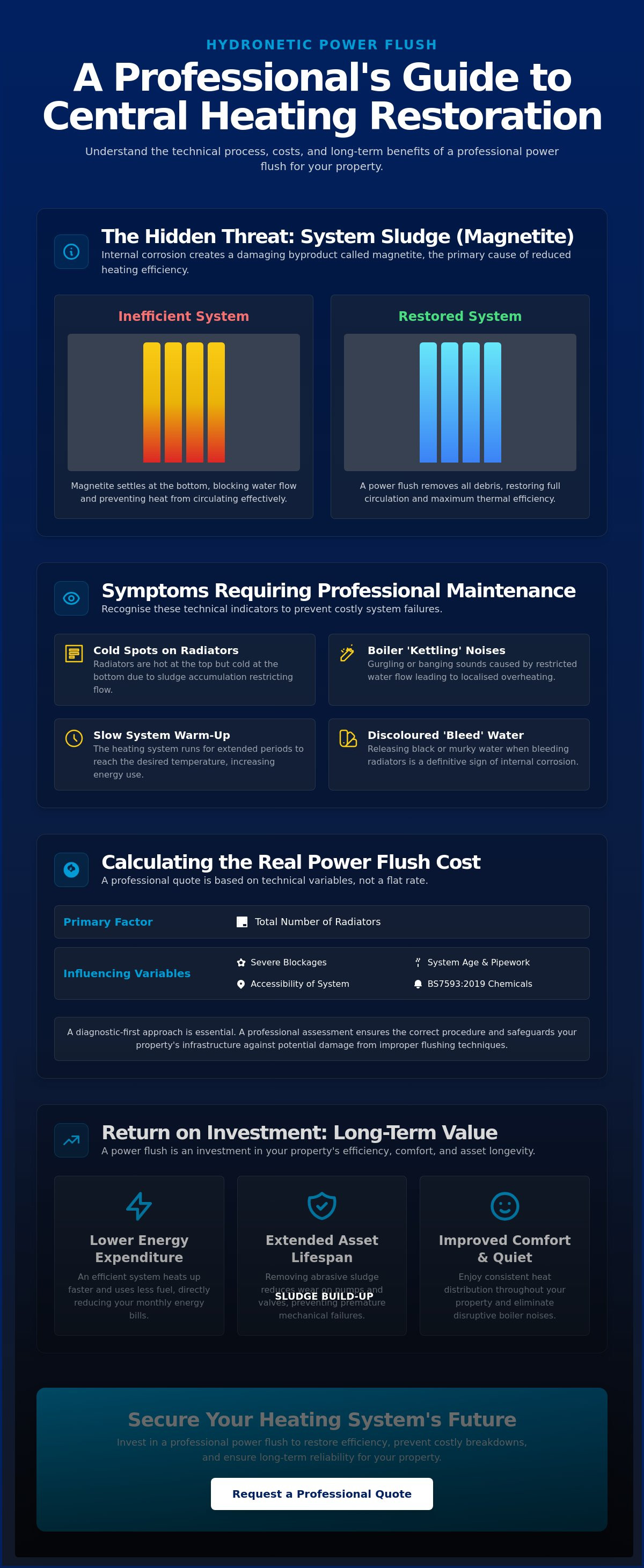
This process is essential because of magnetite, often referred to as black sludge. This substance is a byproduct of internal corrosion that settles within the system, significantly reducing thermal transfer efficiency. When magnetite builds up, your boiler must work harder to push heat into your rooms. Understanding the technical necessity of this service is the first step in evaluating the power flush cost Essex homeowners should anticipate for their specific property type.
To see a professional comparison and real-world example of what this service entails, watch this helpful video:
The Science of System Sludge and Corrosion
Corrosion occurs when water reacts with oxygen and the metallic components inside your radiators. Over time, microscopic rust particles flake off and congregate in low-flow areas, such as the bottom of radiators or within horizontal pipe runs. This sludge doesn't just block heat; it is physically abrasive. It often causes premature wear on circulating pumps and can seize diverter valves, leading to mechanical failures that are far more expensive than routine maintenance. For property owners, staying ahead of these issues is a core part of effective asset preservation.
Symptoms That Indicate Your System Requires Maintenance
Your heating system often provides clear warnings before a total failure occurs. Recognising these signs early can prevent the need for an emergency repair. You should look for these specific indicators:
Radiators that feel cold at the bottom whilst the top remains hot, suggesting a heavy accumulation of sludge.
Persistent "kettling" noises from the boiler, which occur when debris restricts flow and causes localised overheating.
Slow warm-up times that force your system to run for longer periods to reach a comfortable temperature.
Discoloured or black water appearing when you bleed the radiators to release trapped air.
Restoring circulation through a professional flush eliminates these cold spots and quietens the entire system, ensuring your home remains warm and efficient throughout the winter months. By addressing these symptoms, you avoid the escalating power flush cost Essex residents might face if a neglected system leads to a full boiler replacement.
Calculating the Real Cost of a Central Heating Power Flush
When evaluating the power flush cost Essex residents are quoted, it's vital to understand that this isn't a flat-rate commodity. A professional quote is a technical breakdown of labour hours, specialised equipment usage, and high-grade chemical consumables. The primary metric for any domestic quote is the number of radiators in the property. This determines the volume of water within the circuit and the amount of time a technician must spend at each individual heat emitter to ensure a thorough restoration.
A professional HVAC contractor will always factor in the cost of premium chemicals that adhere to the BS7593:2019 code of practice. This standard requires the use of specific sludge removers during the flush and high-quality corrosion inhibitors once the system is refilled. These chemicals aren't optional; they're essential for preventing the immediate return of magnetite. Additionally, the age and material of your pipework play a significant role. Systems using 8mm or 10mm microbore piping often require more time and specialised adapters to ensure the high-velocity flow isn't restricted by the narrow internal diameters.
Domestic vs. Commercial Pricing Structures
There is a distinct difference in complexity between a residential home and a commercial facility. Whilst a three-bedroom house typically operates on a single zone with 8 to 12 radiators, commercial heating circuits often involve multi-zone configurations and industrial-scale boilers. These larger systems require high-capacity pumping stations and significantly more chemical volume. The time requirements also escalate; a commercial flush might span several days to ensure every branch of the circuit is cleared of debris, making the logistical planning far more intensive than a standard domestic visit.
Included Services and Potential Add-ons
Transparency in a quote means knowing exactly what's included in the baseline power flush cost Essex providers present to you. Many reputable specialists include a post-flush certificate, which is often a mandatory requirement for maintaining a boiler's manufacturer warranty. However, you should clarify if certain essential components are included or treated as add-ons. These often include:
The installation of a magnetic system filter to provide ongoing protection against future sludge build-up.
The replacement of seized thermostatic radiator valves (TRVs) which often fail when sludge is present.
A full system balance to ensure heat is distributed evenly across all floors.
By addressing these variables upfront, you ensure your property maintenance budget is used effectively. If you're looking for a methodical approach to system care, it's often worth considering a professional central heating power flush to safeguard your infrastructure. This proactive investment in professional property maintenance prevents the far higher costs associated with emergency boiler failure or full system replacements.
Technical Factors That Influence Your Final Quote
While the number of radiators provides a baseline for pricing, several technical variables can alter the final power flush cost Essex homeowners receive. A professional assessment considers the physical layout of your property and the current internal state of your heating components. System accessibility is a primary factor; if a boiler is located in a restricted loft space or behind bespoke cabinetry, the time required to connect the flushing station increases. Technicians must ensure a secure connection to the circuit without risking damage to your home's interior, which may extend the initial setup phase of the project.
Severe blockages within the primary heat exchanger also influence the total labour hours. When magnetite has hardened into a solid mass, a standard flushing cycle may be insufficient. Technicians often need to use localised vibratory tools or extended chemical circulations to break down these deposits. Furthermore, older systems with fragile pipework or pre-existing pinhole leaks require a more cautious approach. Sludge often acts as a temporary sealant for small leaks in ageing radiators; once this is removed, remedial plumbing work may be necessary to ensure the system remains watertight under normal operating pressure.
System Design and Pipework Complexity
The architecture of your pipework significantly dictates the difficulty of the restoration. Microbore systems, which use narrow 8mm or 10mm copper tubing, are notoriously difficult to clean because the small internal diameter is easily restricted. These systems often require higher pressure differentials and specialised adapters to achieve the velocity needed to move heavy sludge. Similarly, older "one-pipe" configurations lack the direct flow of modern two-pipe systems, requiring a more intensive, radiator-by-radiator approach. To ensure accuracy before providing a quote, specialists often use thermal imaging to identify specific cold spots and stubborn blockages that aren't visible to the naked eye.
Compliance with British Standards (BS7593:2019)
A cut-price service often skips the rigorous requirements set out in the BS7593:2019 code of practice. A compliant power flush cost Essex quote includes a comprehensive three-stage process: cleaning, flushing, and inhibiting. This standard mandates a full system water test to verify that all cleaning chemicals have been successfully neutralised and that the correct concentration of inhibitor is present. This methodical approach ensures that the system is not only clean but also chemically balanced to prevent future corrosion. Professional documentation of these tests adds significant value to your property maintenance records, providing proof of care that is often required by insurance providers and boiler manufacturers to honour long-term warranties.
Evaluating the Return on Investment: Energy Savings and Longevity
The upfront power flush cost Essex homeowners pay is best understood not as an expense, but as a capital investment in a depreciating asset. Your boiler and pipework represent a significant portion of your property's infrastructure value. Allowing that infrastructure to degrade through accumulated magnetite is, in practical terms, a decision to accelerate its depreciation. The financial case for a professional flush extends well beyond a single energy bill; it spans the entire remaining operational lifespan of your heating system.
Consider what a degraded system actually costs you each month. When sludge restricts flow, your boiler's controls compensate by raising the flow temperature to compensate for the loss in thermal transfer. This forces the appliance to operate at a higher modulation range than its design specification requires, consuming more gas for every degree of warmth delivered. The inefficiency is continuous, compounding across every hour of every heating season. Restoring the system to its original design performance doesn't just improve comfort; it fundamentally changes the economics of running your home.
Reducing Monthly Energy Expenditure
A clean system allows the boiler to operate at lower flow temperatures, which is particularly significant for condensing boilers that are designed to recover latent heat from flue gases. This recovery only occurs efficiently when return water temperatures are sufficiently low, a condition that a sludge-free circuit actively supports. Radiators that emit heat uniformly across their entire surface area also reduce the total run-time required to reach a target room temperature. A professional power flush typically pays for itself through energy savings within two to three heating seasons.
Protecting Boiler Warranties and Home Insurance
Many boiler manufacturers include explicit clauses within their warranty documentation requiring that the system water quality meets BS7593:2019 standards. A dirty system can void that warranty entirely, leaving you personally liable for a repair or replacement that could otherwise be covered. A post-flush certificate from a qualified technician serves as documented proof of diligent maintenance, a record that is increasingly requested by both manufacturers and home insurance providers when processing claims related to heating system failures.
Beyond the certificate, the installation of a magnetic system filter following the flush provides ongoing protection. This component continuously captures ferrous particles before they can re-accumulate within the heat exchanger, preserving the water quality between service visits. The combined effect of a thorough flush and a quality filter is a system that degrades far more slowly, extending the operational lifespan of your primary heat exchanger by a meaningful margin.
Emergency boiler repairs caused by seized components are consistently more expensive than the preventative maintenance that would have avoided them.
A premature boiler replacement, often triggered by a heat exchanger that has been corroded beyond recovery, represents the highest possible cost outcome for any homeowner.
Documented system maintenance strengthens your position when negotiating warranty claims or insurance settlements.
Protecting your heating infrastructure is a core responsibility of sound property management. If you're ready to restore your system's original performance and lock in those long-term savings, speak with a specialist about a professional central heating power flush tailored to your property's specific requirements.
Securing Your Heating System with Hydronetic Power Flush
At Hydronetic, we don't treat system maintenance as a secondary task. We are dedicated specialists focused on technical restoration. General plumbing firms often lack the high-capacity pumping equipment or the specific chemical expertise required for a true system recovery. Our methodical approach ensures that every power flush cost Essex quote we provide reflects a comprehensive, engineered solution rather than a superficial flush amongst the many varying options on the market. We prioritise the health of your boiler and pipework by identifying the root cause of circulation issues before we even connect our equipment. This diagnostic-first mindset is what separates a professional restoration from a temporary fix.
Choosing a specialist company provides a level of precision that a generalist simply cannot match. We understand that your heating system is a complex network of valves, pumps, and heat exchangers that require individual attention. Our technicians provide detailed reporting for every property we service, giving you a clear audit trail of the system's condition before and after the procedure. This transparency builds trust and ensures you're receiving the long-term value your property deserves.
The Hydronetic Diagnostic Process
Our process begins with a thorough technical assessment. We use high-resolution thermal imaging to map exactly where magnetite has settled within your radiators and pipework. This allows us to target stubborn blockages with precision, ensuring heat is restored to every corner of the room. We then apply a chemical dosing strategy specifically tailored to the age and material of your system. This bespoke chemistry ensures we dissolve sludge effectively without compromising older joints or delicate components. Every project concludes with a final water quality test. This analysis confirms the system is neutralised and protected by the correct concentration of inhibitors, providing you with a verifiable record of the work performed.
Ready to Restore Your Heating Efficiency?
Restoring your home's thermal efficiency starts with a clear understanding of your system's specific requirements. When you request a bespoke quote, we provide a transparent breakdown of the work required for your residential or commercial property. On the day of service, our technicians respect your environment by using protective coverings and maintaining a clean work site throughout the process. You can learn more about our comprehensive central heating power flush service to see how we maintain these professional standards. If your boiler has been making unusual noises or losing pressure, it's also helpful to understand how we clear stubborn boiler blockages before they lead to a complete mechanical failure. Our goal is to provide long-term value, moving beyond quick fixes to ensure your heating assets are preserved for years to come. By choosing a specialist, you're securing the peace of mind that comes with technical excellence and transparent reporting of the power flush cost Essex investment you've made in your home.
Securing Long-Term Efficiency for Your Property
Maintaining a central heating system is a core part of responsible property management. By addressing magnetite accumulation early, you protect your primary heating assets from premature failure and ensure monthly energy expenditure remains manageable. We've explored how a technical restoration differs from a standard rinse, highlighting the importance of methodical diagnostic testing. Understanding the transparent factors behind the power flush cost Essex homeowners are quoted allows you to prioritise long-term value over temporary, cut-price fixes.
Hydronetic provides a specialist focus on system restoration, utilising advanced thermal imaging diagnostics to map blockages with precision. Every procedure we perform is fully BS7593 compliant, ensuring your boiler warranty remains protected and your system operates at its original design performance. Don't wait for a total system failure to address rising bills or cold radiators. You can Request a Professional Power Flush Quote from Hydronetic today to secure the comfort and efficiency of your property. Taking this proactive step now ensures a quiet, reliable heating system for the years ahead.
Frequently Asked Questions
How much does a power flush cost on average in the UK for 2026?
The average cost for a professional flush in the UK generally ranges from £350 to £850 depending on the property size and radiator count. This investment covers the labour of a specialist technician, high-grade chemicals, and the use of industrial pumping equipment. Whilst regional variations are common, obtaining a specific power flush cost Essex quote ensures you receive a price that accurately reflects your property's unique system design and accessibility requirements.
Does a power flush include the cost of a magnetic filter?
A magnetic filter is typically treated as a separate component and isn't always included in the base quote for a flush. Specialists often recommend installing one during the procedure to provide ongoing protection against future magnetite build-up. It's a proactive maintenance step that captures ferrous particles before they enter the boiler's heat exchanger, preventing mechanical damage and ensuring the system water remains clean between scheduled service intervals.
Will a power flush cause leaks in my existing radiators or pipes?
A power flush doesn't create new leaks; however, it can reveal pre-existing pinholes that were previously sealed by internal sludge. As the high-velocity water removes corrosive debris, it might expose areas where the metal has already thinned due to neglect. Technicians perform pressure tests before and after the service to ensure system integrity and'll advise on remedial work if any underlying weaknesses are identified during the restoration process.
How long does the power flushing process typically take?
A thorough power flush for a standard three-bedroom property usually takes between six and ten hours to complete. Larger homes or commercial systems with complex multi-zone layouts can extend into a second day of work. The process is methodical, requiring individual attention for each radiator to ensure every branch of the circuit is cleared of internal blockages and chemical residues before the final corrosion inhibitor is added.
Is a power flush necessary if I am installing a new boiler?
Yes, performing a flush before installing a new boiler is essential for protecting your investment and maintaining the manufacturer's warranty. Modern boilers have narrow internal waterways that are easily blocked by old sludge from the existing pipework. Without a clean circuit, the new appliance'll operate at reduced efficiency and may suffer premature component failure, potentially voiding your long-term cover and leading to expensive emergency repairs.
Can I perform a power flush myself to save on costs?
Attempting a DIY power flush isn't recommended due to the technical expertise and high-capacity pumping equipment required for a successful result. Incorrectly handled chemicals or insufficient flow rates can lead to incomplete cleaning or, in worse cases, damage to delicate boiler components. Professional technicians use diagnostic tools like thermal imaging to verify the results, providing a level of accuracy and protection that consumer-grade equipment simply can't achieve.
How often should a central heating system be power flushed?
Most industry specialists recommend having your central heating system power flushed every five to six years to maintain optimal thermal efficiency. Regular maintenance prevents the gradual accumulation of magnetite, which is the primary cause of internal corrosion and circulation issues. If you've recently moved into a property with an unknown service history, a diagnostic water test can determine if a flush is required sooner to safeguard the system.
What happens if I ignore the signs that my heating needs a flush?
Neglecting signs of system sludge leads to escalating energy bills and a significantly higher risk of catastrophic boiler failure. As blockages worsen, the circulating pump must work harder, causing premature wear and eventual seizure. Internal corrosion'll continue unabated, eventually eating through radiator walls and heat exchangers. This neglect turns a manageable maintenance task into an expensive emergency replacement of your property's most critical infrastructure.


Comments