

Local Dartford Plumbers, covers SE London & Kent
- Darrell Willamson
- Jun 15
- 12 min read
What if the reason your energy bills are climbing isn't just the rising cost of gas, but the thick, black sludge silently accumulating inside your radiators? It's a common frustration for homeowners across Dartford and SE London who find themselves turning up the thermostat whilst the bottom of the radiator remains stubbornly cold. You've likely noticed your boiler making strange kettling noises or felt the stress of a heating system that simply isn't performing like it used to. It's easy to assume these are just signs of an ageing system, but often, it's a symptom of internal corrosion that requires a specialist's touch.
Finding reliable Local Plumbers who understand the nuances of system restoration is the first step towards reclaiming your home's comfort. In this guide, you'll discover how to identify the right professionals for the job and gain a clear understanding of the technical factors that determine the cost of a central heating power flush. We will examine the diagnostic process, the impact of sludge on your utility bills, and how this essential maintenance ensures you remain compliant with your manufacturer's warranty requirements. By the end, you'll know exactly how to restore efficiency and safeguard your heating system for the long term.
Key Takeaways
Learn why system restoration requires specialist equipment and chemicals rather than standard general plumbing tools.
Identify the technical variables, such as radiator count and system age, that determine the total investment for a power flush.
Understand how to verify the credentials of Local Plumbers, ensuring they hold the necessary Gas Safe registrations and liability insurance.
Discover the long-term financial benefits of clearing internal sludge, including lower utility bills and extended boiler lifespan.
See how a methodical, diagnostic approach to cleaning your central heating can resolve noisy boilers and cold spots.
Table of Contents
Understanding the Role of Local Plumbers in Heating Maintenance
Many property owners assume that all Local Plumbers offer the same range of services. In reality, the professional landscape is divided between general maintenance and specialised heating restoration. Whilst a generalist is ideal for fixing a burst pipe or a leaking tap, the intricate nature of a central heating system requires a technician with specific diagnostic training. The field of Plumbing is broad, but restoring a fouled heating system is a distinct technical discipline that goes far beyond basic pipework.
Professional system restoration involves more than just a basic toolkit. It requires industrial-strength pumping units and chemical neutralisers that aren't typically found in a standard plumbing van. This technical focus ensures that the internal surfaces of your radiators and heat exchangers are thoroughly cleaned, rather than just temporarily patched. To better understand how to work effectively with a service professional, watch this helpful video:
General Plumbers vs. Heating Specialists
Generalists are the backbone of domestic property maintenance. You should call them for sanitaryware installations, waste pipe repairs, and minor leaks. However, central heating restoration amongst older Kent and London properties requires a specialist who understands the chemical behaviour of system water. These experts focus on the "health" of the boiler, clearing blockages in the heat exchanger and ensuring the pump operates without resistance. For more technical guides on property upkeep, you can explore our blog.
The Problem of System Sludge (Magnetite)
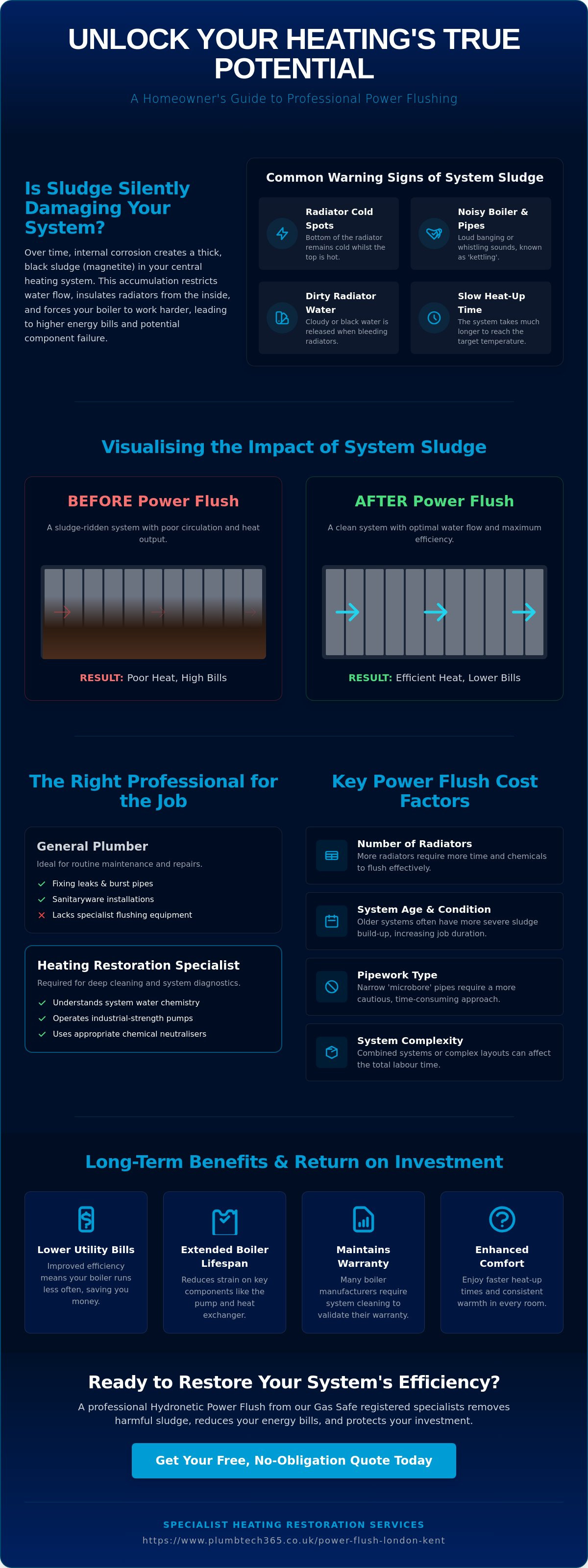
What exactly is the sludge that plagues so many UK homes? It's a combination of rust and debris that detaches from the internal walls of steel radiators. Over several years, this magnetite settles into a thick, mud-like consistency. It doesn't just sit there; it actively restricts water flow and acts as an insulator, preventing heat from reaching the room. This forces your boiler to work harder, increasing wear on expensive components.
Common signs that your system is suffering from magnetite accumulation include:
Radiators that remain cold at the bottom whilst the top is warm.
A boiler that makes a loud banging or whistling sound, often called "kettling".
Cloudy or black water appearing when you bleed your radiators.
The central heating taking significantly longer to reach temperature than it did previously.
A professional flush restores optimal heat distribution by mechanically forcing these deposits out of the system. This process is far more effective than simple radiator balancing, as it removes the root cause of the inefficiency rather than just masking the symptoms. Hiring Local Plumbers with specific heating qualifications ensures the job is done safely and effectively.
Key Factors Affecting Power Flush Cost for UK Properties
Understanding the cost of a power flush requires looking beyond a simple hourly rate. Professional Local Plumbers evaluate the physical layout and condition of your property to ensure the quote reflects the actual labour and materials required. It's always wise to check you can trust them by reviewing their diagnostic approach and ensuring they've accounted for the specific technical needs of your heating system before work begins.
The age and material of your pipework are critical factors. Properties with microbore pipework, often found in homes built in the 1970s and 80s, require a more cautious approach because the narrow diameter makes them prone to total blockages. Conversely, very old iron pipework may be fragile and requires a technician who can balance pressure with effectiveness. The severity of the magnetite accumulation also influences the duration of the flush; a system that hasn't been cleaned in over a decade will harbour significantly more debris than a system with a regular maintenance history. System complexity directly correlates to the volume of specialised chemicals and the duration of the pumping cycles required for a successful restoration.
System Size and Radiator Count
The number of radiators serves as the primary baseline for any quote. Larger properties with ten or more radiators present a different challenge than a small flat, as they require more intensive flushing cycles to ensure complete debris removal. Each radiator must be individually isolated and flushed to ensure every gram of magnetite is forced out. If you have a multi-zone heating system, the process becomes more intricate. The technician must navigate various motorised valves and separate circuits to reach every corner of the pipework, ensuring no pockets of sludge remain to re-contaminate the system later.
Boiler Integration and Heat Exchanger Health
The boiler is the heart of the system and often where the most damage occurs. Sludge typically settles within the narrow channels of the heat exchanger, which can lead to overheating and the noisy operation mentioned previously. Clearing these specific blockages is a more delicate operation than a standard radiator flush and requires the technician to have clear access to the system pump and internal valves. If your boiler is located in a restricted space, such as a loft or a tightly packed kitchen cupboard, the setup time for the equipment may increase. You can find more detailed advice in this Boiler Blockage Clearance: A Homeowner’s Guide.
For homeowners in SE London or Kent, choosing a specialist for a local central heating power flush ensures your boiler remains protected and your energy efficiency is restored through a methodical, professional process.
How to Vet and Select Qualified Local Plumbers
Hiring a tradesperson to work on your central heating system is a decision that impacts your property's long-term safety and efficiency. Whilst many Local Plumbers claim expertise, verifying their credentials is the only way to safeguard your investment. You should always consult UK government advice on hiring plumbers to understand the baseline for professional standards. At a minimum, any engineer working on your boiler must be Gas Safe registered. This isn't just a recommendation; it's a legal requirement for anyone touching gas appliances in the UK.
Beyond gas safety, check for professional indemnity and public liability insurance amongst the Local Plumbers you are considering. These policies protect your home in the unlikely event of accidental damage during the flushing process. The equipment used is another indicator of quality. Professional firms utilise high-flow, low-pressure pumps designed specifically for system restoration. DIY kits or repurposed pumps lack the power to dislodge stubborn magnetite and can sometimes cause more harm than good by pushing debris deeper into the boiler.
Compliance with British Standard BS7593
BS7593 is the industry code of practice for the preparation, commissioning, and maintenance of domestic central heating and cooling water systems. It outlines how a system should be cleaned and protected. Following these standards is often a non-negotiable requirement for maintaining a new boiler warranty. If you can't prove the system was flushed and treated according to BS7593, the manufacturer may refuse to honour your warranty if the heat exchanger fails due to sludge. A professional service includes the application of chemical inhibitors, which form a protective layer on internal surfaces to prevent future corrosion.
Questions to Ask Before Booking
Before you commit to a service, ask the engineer about their specific methodology. A transparent specialist will be happy to explain their process. Consider asking the following:
Which specific chemicals and flushing machines will be utilised?
Do you provide a thermal imaging check to confirm the removal of radiator cold spots?
Will I receive a water quality certificate and a post-flush report?
A post-flush report is essential for your records, providing evidence that the water quality meets the required standards. This document is your proof of maintenance should you ever need to make a warranty claim. For more guidance on managing your physical assets, visit the PPS Property Maintenance Blog for detailed maintenance checklists.
The Long-Term ROI of Professional System Restoration
Viewing professional system restoration as a long-term financial strategy is essential for any property owner. When you engage experienced Local Plumbers, you aren't just paying for a one-off service; you're investing in the longevity of your property's most expensive mechanical asset. A clean system operates with significantly less friction, which translates directly into lower fuel consumption and a reduced strain on the boiler's internal components. This proactive approach turns a maintenance cost into a measurable saving over the following years.
Sludge is an incredibly poor conductor of heat. When it coats the inside of your radiators, it acts as an insulator, effectively trapping the heat inside the metal rather than allowing it to radiate into the room. This means your boiler must burn more gas to achieve the same ambient temperature you enjoyed when the system was first installed. By removing this barrier, you improve the "warm-up" speed of the entire property. Rooms reach the desired temperature faster, allowing the boiler to modulate down or switch off sooner. You can learn more about how this process affects your taps and showers in our guide on why power flushing restores hot water flow.
Beyond the monthly bills, consider the cost of major repairs. A system fouled with magnetite is a leading cause of pump failure and heat exchanger blockages. These are not minor fixes; they often involve expensive parts and high labour costs. Regular maintenance by qualified Local Plumbers reduces the frequency of these emergency call-outs. It's the difference between a controlled maintenance schedule and a stressful mid-winter breakdown that leaves your tenants or family without heat.
Energy Efficiency and Bill Reduction
The removal of magnetite leads to immediate improvements in thermal efficiency. Whilst exact savings depend on the initial level of contamination, some industry professionals report that a heavily fouled system can be significantly less efficient than a clean one. Restoring this lost performance ensures every pound spent on energy actually goes towards heating your home rather than fighting against internal blockages. This reduction in fuel consumption is one of the fastest ways to see a return on your maintenance investment.
Asset Preservation for Landlords
For those managing a property portfolio, preventative maintenance is a core component of facility management. Landlords must balance tenant comfort with long-term operational costs. A full system replacement is a capital-intensive project that can often be deferred for years through regular professional flushing. To ensure your properties remain compliant and efficient, it's beneficial to integrate these checks into your broader PPS Property Maintenance Services for facility management.
If your heating system is showing signs of neglect, booking a local central heating power flush is the most effective way to secure these long-term savings and protect your boiler's warranty requirements.
Hydronetic Power Flush: Specialist Solutions for UK Homes
Our methodical approach to power flushing is engineered to surpass general plumbing standards by focusing solely on the mechanical restoration of your heating system. Whilst many Local Plumbers provide a broad range of domestic services, we believe that clearing stubborn boiler blockages and restoring uniform heat distribution requires a dedicated specialist mindset. We don't just clean pipes; we provide transparent, technical assessments that prioritise the long-term health of your boiler and radiators. This disciplined focus ensures your home is protected against the risk of costly winter breakdowns and ensures every component operates exactly as the manufacturer intended.
Transparency is a core part of our service. We don't believe in quick fixes that only mask the symptoms of a failing system. Instead, we provide a detailed overview of the "how" and "why" behind every action we take. This includes explaining the chemical reactions required to break down magnetite and the mechanical processes used to purge it from your property. By choosing specialists, you're partnering with technicians who have seen every possible system configuration and know exactly how to rectify poor circulation issues safely and effectively.
Our Problem-Solving Methodology
Before any equipment is activated, we use advanced diagnostic techniques to identify specific system weaknesses. This involves mapping thermal inconsistencies to find exactly where magnetite has settled within your radiators. We are committed to restoring performance whilst respecting the integrity of your existing pipework. This is vital for older properties in Kent and SE London where narrow pipes or aged joints require a careful, controlled approach. By specialising in maintenance rather than new installations, we maintain a level of focused expertise that generalists often cannot match. We understand the specific stresses placed on older building systems and tailor our flushing pressure to suit the age and material of your installation.
Book Your System Health Check
Protecting your property's value starts with a professional assessment. A specialist-led maintenance programme provides peace of mind, ensuring every component is functioning at its peak efficiency before the cold weather sets in. If you're ready to reclaim your home's comfort and lower your utility bills, you can discover more in our Central Heating Power Flush: The Ultimate 2026 Homeowner Guide. Contacting us for a technical health check is a straightforward step towards safeguarding your heating system for years to come. Our Local Plumbers are ready to provide the expert maintenance required to keep your home warm and your boiler warranty fully compliant.
Securing Your Home’s Heating Future
Restoring a central heating system is a technical investment that demands more than a generalist's toolkit. By understanding the factors that influence cost and the necessity of adhering to British Standard BS7593, you ensure your property remains efficient and your boiler warranty stays protected. Choosing a specialist ensures that internal corrosion is physically removed rather than ignored, leading to lower utility bills and a more comfortable living environment. When vetting Local Plumbers, prioritising technical expertise over the lowest quote safeguards your home against premature component failure.
Our service provides a specialist power flushing focus with specific expertise in boiler blockage clearance. We provide comprehensive system health reports so you have a clear record of your maintenance history. Restore your heating efficiency with Hydronetic Power Flush and gain the peace of mind that comes from a methodical, professional restoration. Taking action now prevents the stress of a winter breakdown and ensures your heating system serves you reliably for years to come.
Frequently Asked Questions
Is a power flush worth the money for older heating systems?
Yes, it is particularly valuable for older systems as it removes years of accumulated magnetite that a standard drain-down cannot reach. By clearing these deposits, you restore the thermal efficiency of the property and protect ageing components from failure. This preventative measure is significantly more cost-effective than replacing a boiler or multiple radiators that have succumbed to internal corrosion.
How long does a professional power flush take to complete?
A standard professional power flush typically takes between six and ten hours to complete, depending on the number of radiators. Larger properties or systems with severe blockages may require a full day of intensive cleaning. This duration allows for each radiator to be isolated and flushed individually, ensuring that all debris is mechanically removed from the circuit rather than just redistributed.
Can local plumbers perform a power flush without specialised equipment?
No, a genuine power flush requires high-flow, low-pressure pumping units and specific chemical cleaners that standard toolkits don't include. Whilst some Local Plumbers might offer a system rinse, this lacks the velocity needed to dislodge hardened sludge. Effective restoration relies on the mechanical force generated by industrial-grade equipment to purge the entire system of magnetite and debris.
What are the main factors affecting the cost of a power flush?
The primary variables include the total radiator count, the age of the pipework, and the severity of the internal blockages. Systems with microbore piping or those that haven't been maintained for over a decade often require more time and specialised chemicals. Additionally, the accessibility of the system pump and the type of boiler installed will influence the total labour required for the setup and execution.
Will a power flush fix a noisy or kettling boiler?
Yes, a power flush is the most effective solution for kettling noises caused by sludge accumulation in the heat exchanger. These sounds occur when debris restricts water flow, causing the water to overheat and turn to steam. By clearing these internal deposits, you restore smooth circulation and quiet operation, extending the lifespan of your boiler's most critical components.
How often should a central heating system be flushed?
Industry standards generally recommend a professional flush every five to ten years, depending on the system's usage and water quality. However, you should consider a flush immediately if you notice cold spots on radiators or if you are installing a new boiler. Proactive maintenance by qualified Local Plumbers ensures that your system remains efficient and compliant with manufacturer warranty requirements.
What happens if I ignore the sludge in my radiators?
Ignoring sludge leads to a progressive decline in heating performance and eventually results in total system failure. Magnetite is highly corrosive and will eventually eat through radiator walls, leading to leaks and property damage. Internally, it creates blockages that force the pump to work harder, which significantly increases the risk of an expensive boiler breakdown during the winter months.
Does a power flush include the boiler and the radiators?
Yes, a comprehensive power flush cleans the entire circuit, including the boiler's heat exchanger, all radiators, and the interconnecting pipework. The process involves circulating high-velocity water and chemicals through every part of the system to ensure no pockets of debris remain. This holistic approach is essential for restoring the overall health and heat distribution of your property's heating installation.


Comments