Expert Radiator Maintenance in London: Restoring Heating Efficiency in 2026
- Darrell Willamson
- Jun 1
- 12 min read
Did you know that 87% of heating system failures are the direct result of dirty system water? If you've noticed cold spots at the bottom of your radiators or heard your boiler making strange noises in your London home, you're likely dealing with magnetite buildup. This metallic sludge forces your system to work harder, which drives up your monthly energy costs. Professional radiator sludge removal London is the most effective mechanical solution to clear these blockages and restore your home's heating efficiency.
We know how frustrating it is to deal with high bills and the constant fear of a boiler breakdown. Hydronetic Power Flush is here to help you protect your home and ensure your domestic comfort. This article explains how a specialized Power Flush eliminates internal debris and why a Central Heating Power Flush is essential for system longevity. You'll see how a Radiator Power Flush restores heat distribution and keeps your system running quietly through the coldest months of the year.
Key Takeaways
Learn how to identify internal corrosion using a simple diagnostic "Tap Test" before it leads to a total system failure.
Understand the mechanical science behind radiator sludge removal London and how it eliminates the metallic debris that causes inefficient cold spots.
Compare the benefits of a standard chemical clean against a high-velocity Radiator Power Flush to determine which restoration method suits your home's pipework.
See how a Central Heating Power Flush from your Local Power Flush Company ensures your system operates quietly while significantly reducing monthly energy consumption.
Explore why specialist maintenance is vital for London properties to prevent boiler blockage and extend the lifespan of your entire heating circuit.
Table of Contents
The Critical Need for Professional Radiator Maintenance in London
Understanding the 'Sludge' Crisis: Why Your Radiators are Cold
Power Flushing vs. Standard Servicing: Choosing the Right Care
Identifying When Your London Home Requires Specialist Intervention
Hydronetic’s Specialist Approach to London Radiator Maintenance
The Critical Need for Professional Radiator Maintenance in London
Professional radiator maintenance is a comprehensive mechanical restoration process. It's designed to return your central heating system to its peak operational state. For homeowners across the United States, this process is vital because of varying local water qualities. It isn't just a surface check. Unlike general plumbing, which often focuses on external leaks, specialist maintenance addresses the hidden chemical reactions occurring inside your pipes and radiators.
Hard Water and System Efficiency
Many US regions suffer from high mineral content in the water supply. When this water is heated, it forms limescale. Inside your radiators, this scale acts as a bonding agent for iron oxide, the byproduct of internal corrosion. This mixture creates a dense layer that standard chemical cleaners can't always shift. Specialist radiator sludge removal London is required to break down these deposits and flush them out of the circuit entirely. If left untreated, this debris can cause permanent damage to your boiler’s internal heat exchanger.
The Financial Case for Maintenance
Neglecting your system health is a costly decision. In 2026, energy efficiency is a primary driver for homeowners, and a system choked with sludge is significantly less efficient. This means you're paying for fuel that isn't warming your home. Investing in a Radiator Power Flush provides a clear return on investment through several factors:
Reduced Energy Consumption: Clean radiators heat up faster and distribute warmth evenly, shortening boiler cycle times.
Component Protection: You avoid the need for a Boiler Blockage Clearance by keeping the pump clear of abrasive debris.
Warranty Compliance: Most manufacturers now require proof of a professional Power Flush to honor the terms of your boiler's warranty.
By prioritizing preventative care with Hydronetic Power Flush, you avoid the high emergency call-out premiums common during the peak winter months. A methodical approach to maintenance ensures long-term reliability and keeps your monthly utility costs as low as possible.
Understanding the 'Sludge' Crisis: Why Your Radiators are Cold
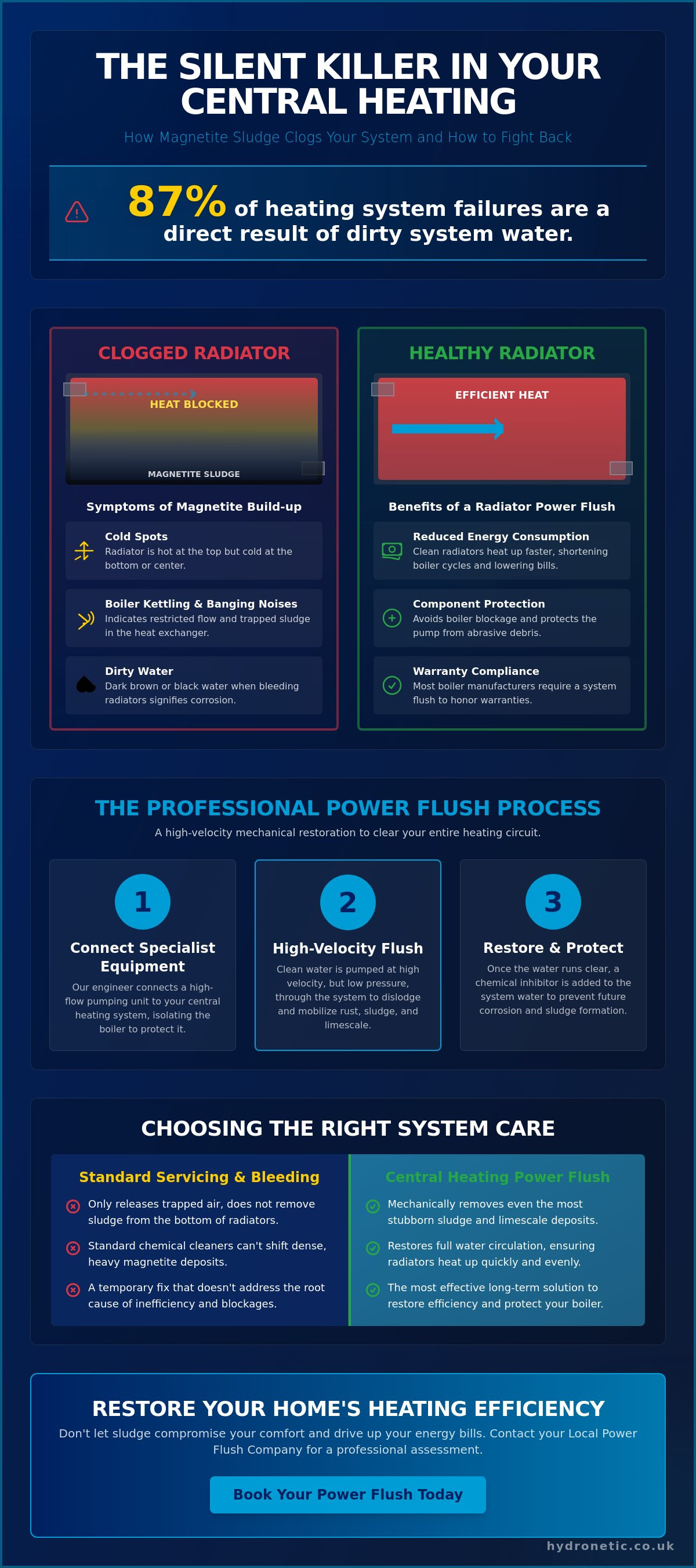
Inside your home's heating system, a specific chemical byproduct known as magnetite is likely the culprit behind those cold radiators. This black iron oxide forms when water reacts with the steel internal surfaces of the system. Because magnetite is significantly heavier than water, it naturally settles at the lowest points. This is why you'll often find the top of a radiator is hot while the base remains stone-cold. It's a physical blockage, not a valve issue. Over time, these microscopic particles clump together to form a dense, mud-like substance that effectively chokes your heating circuit.
Many homeowners across the US mistakenly believe that bleeding their radiators will solve the problem. While bleeding releases trapped air from the top, it does nothing to move the heavy deposits at the base. True restoration requires a Radiator Power Flush to physically dislodge and eject the settled magnetite. Understanding The Critical Need for Professional Radiator Maintenance is vital because this sludge is a "silent killer" for your boiler. As debris circulates, it acts like liquid sandpaper, wearing down the pump and clogging the heat exchanger. If you suspect your system is losing efficiency, a specialist diagnostic assessment from Hydronetic Power Flush can confirm the extent of the buildup before it leads to a total mechanical failure.
Symptoms of Magnetite Build-up
Identifying the early warning signs of internal corrosion can save you from an expensive Boiler Blockage Clearance later. Look out for these specific indicators:
Temperature Variance: The most common sign is a radiator that's hot at the top but cold at the bottom or in the center.
Contaminated Water: If you perform a test bleed and the water appears dark brown or jet black, your system is heavily oxidized.
Boiler Kettling: Unusual noises from the boiler, such as banging or whistling, often indicate that sludge is trapped in the primary heat exchanger.
The Mechanical Impact on Circulation
Sludge increases internal friction, forcing the central heating pump to work much harder to move water. This raises electricity usage and shortens the pump's lifespan. In many residential layouts featuring narrow-gauge pipework, even small amounts of magnetite can cause total blockages that leave entire rooms without heat. A Central Heating Power Flush is the only way to clear these restricted channels and ensure even heat distribution. By opting for a Power Flush from a Local Power Flush Company, you address the root cause of circulation failure. Professional radiator sludge removal London ensures your system operates at the high efficiency levels required in 2026.
Power Flushing vs. Standard Servicing: Choosing the Right Care
Many homeowners assume that a standard annual boiler service includes a deep clean of the pipework. This is a common misconception. A standard service focuses on the boiler's combustion and safety, whereas radiator sludge removal London requires a targeted mechanical approach. While a general plumber might offer a "chemical flush" by adding a bottle of cleaner to the header tank, this method is often insufficient for removing years of compacted magnetite. It relies on the system's existing pump, which is usually already struggling due to the very blockages it's trying to clear.
Choosing a Local Power Flush Company ensures that the restoration is handled with industrial-grade equipment. A specialist doesn't just add chemicals; they utilize a high-velocity, low-pressure machine that moves water much faster than your central heating pump ever could. This mechanical force is necessary to lift heavy, settled debris from the bottom of radiators and transport it out of the system. Without this velocity, the sludge simply remains in place, continuing to restrict heat and waste energy.
The Power Flushing Process Explained
A Central Heating Power Flush is defined as the mechanical removal of contaminants using an external pumping station. This machine circulates water at a high flow rate but keeps the pressure low to protect your system's joints and seals. We use specialized alkaline cleaners to break down the bond between rust and scale, allowing the machine to capture the suspended waste in a powerful magnetic filter. This Radiator Power Flush process is far more effective than a gravity-fed rinse because it forces water through every internal channel of the radiator, ensuring no cold spots are left behind.
When to Choose a Specialist Over a Generalist
The difference between a plumber’s quick rinse and a technician’s deep clean lies in the methodology. A generalist may lack the tools required for a complex Boiler Blockage Clearance, which often involves cleaning the primary heat exchanger. Our technicians perform individual radiator agitation, using vibration tools to ensure every pocket of sludge is mobilized. This level of detail is essential for restoring systems that have been neglected for several years.
It's vital to assess the age of your property before proceeding. In some older London homes with thin-walled iron pipes, a high-velocity Power Flush might be too aggressive. A specialist will identify these risks during the initial inspection, ensuring your system is robust enough for the procedure. To maintain long-term health, the BS 7593:2019 standard now mandates the installation of a permanent in-line magnetic filter. This device captures new debris before it can settle, acting as a permanent guard for your restored system. A specialist Power Flush is the gold standard for London homes because it addresses the unique mineral scaling issues found in the Thames Valley, providing a level of cleanliness that a simple rinse cannot match.
Identifying When Your London Home Requires Specialist Intervention
Recognizing the early stages of system decay is essential for maintaining a reliable home. While internal corrosion is often invisible, your heating system provides clear physical indicators when it's under stress. Homeowners can perform a simple mechanical assessment known as the "Tap Test" to check for sludge without opening the system. Gently tap the bottom of your radiator panels with a solid object. A dull, heavy thud instead of a clear, metallic ring suggests a significant accumulation of settled magnetite. If your radiators fail this test, it's a primary indicator that you need professional radiator sludge removal London to restore thermal conductivity.
Recurring trapped air is another symptom that's frequently misunderstood. If you find yourself bleeding the same radiators every few weeks, you aren't just dealing with air; you're likely seeing the byproduct of a chemical reaction. As steel radiators corrode internally, they release hydrogen gas. This gas collects at the top of the system, mimicking the symptoms of a simple air lock. Frequent venting is a warning that your system's protective inhibitors have failed and active corrosion is occurring. A Power Flush from a Local Power Flush Company is the only way to stop this process and reset the system's chemistry.
The Diagnostic Checklist
Use this checklist to evaluate if your system requires a Radiator Power Flush:
Delayed Warm-up: Does the radiator take more than 20 minutes to feel warm after the heating is turned on?
Thermal Variance: Is there a significant temperature difference between the top and bottom panels when you touch them?
Inconsistent Distribution: Are some radiators in the house perfectly hot while others in different rooms stay lukewarm?
Discoloured Water: If you perform a test bleed, does the water appear dark, cloudy, or thick?
Boiler Warning Signs
Your boiler's behavior is the most critical diagnostic tool for assessing system health. When sludge restricts flow, the boiler can't dissipate heat quickly enough, leading to "short-cycling" where the unit turns on and off rapidly. You might also notice frequent lockouts or error codes related to circulation and overheating. These aren't necessarily signs of a broken boiler; they're often safety responses to a Boiler Blockage Clearance issue. Learning how to remove black sludge from radiators is a vital step in protecting these expensive components. If your boiler is cycling or making kettling noises, it's time to book a Central Heating Power Flush to clear the internal blockages before they cause permanent mechanical damage.
Hydronetic’s Specialist Approach to London Radiator Maintenance
Hydronetic operates with a single-minded focus: the mechanical restoration of central heating systems. We aren't general plumbers who handle leaky taps or bathroom installs; we're a Local Power Flush Company dedicated to solving complex circulation issues. Our technicians provide specialized services across London, Essex, Kent, and Surrey, ensuring that homeowners can enjoy a warm, efficient home without the massive expense of a new boiler. By concentrating exclusively on radiator sludge removal London, we've developed a methodical process that achieves results where standard plumbing attempts often fail.
We understand that London’s residential properties require a high degree of respect and care. Our team ensures a mess-free experience by using specialized equipment and protective coverings, making the process seamless even in high-end environments. It's our priority to protect your home while we work. Our goal is to prove that your current system can be saved through precise mechanical intervention, restoring hot water production and heating efficiency without the need for a full system replacement.
Specialist Equipment and Techniques
The effectiveness of our Radiator Power Flush lies in the quality of our tools. We utilize high-strength magnetic separators designed to capture 99% of dislodged sludge as it moves through our pumping station. This prevents the debris from simply settling elsewhere in your pipework. This level of filtration is particularly effective for Boiler Blockage Clearance, where we target the primary heat exchanger to restore flow and prevent overheating. For a deeper look at our technical methodology, you can consult our Central Heating Power Flush guide.
Long-Term Protection and Aftercare
Restoring your system is only the first stage of our specialist approach. Once the Power Flush is complete, we perform a post-flush water treatment using high-quality chemical inhibitors. These chemicals form a protective film on the internal surfaces of your radiators, significantly slowing the rate of future corrosion. This protective layer is essential in London’s hard water areas where mineral scaling is an ongoing threat.
To ensure your system remains in peak condition, we also provide professional advice on the installation of permanent in-line magnetic filters. These devices serve as a continuous guard, capturing any new magnetite before it can reach your boiler. This proactive strategy aligns with current BS 7593:2019 standards, focusing on long-term prevention rather than just temporary repairs. If you're tired of cold spots and rising bills, book your London radiator health check today and let a specialist restore your home’s comfort.
Securing Your Home’s Heating Health for the Future
Maintaining a high-efficiency heating system in 2026 requires more than just an annual boiler check; it demands a proactive approach to the mechanical health of your entire circuit. By addressing the root cause of cold spots through professional radiator sludge removal London, you're not just restoring comfort. You're actively extending the lifespan of your boiler's most sensitive components. A targeted Central Heating Power Flush ensures that magnetite and mineral scale are physically removed, allowing your system to operate at the peak performance levels mandated by modern standards.
Hydronetic provides a specialist focus on Boiler Blockage Clearance and system restoration across London, Essex, Kent, and Surrey. We've seen how a methodical Radiator Power Flush can restore full heat distribution to a home without the unnecessary expense of a new boiler. Our technicians use industrial-grade magnetic filtration to ensure your pipework is clear and your energy bills remain manageable. This disciplined approach to maintenance safeguards your property against the risks of neglect.
Restore your heating efficiency with a specialist London Power Flush and gain the peace of mind that comes with a professionally maintained home. Don't wait for a total system failure to address the hidden issues inside your radiators. Taking action today ensures your home remains warm and efficient for years to come.
Frequently Asked Questions
How often should radiators be maintained in a London home?
Professional maintenance should follow the BS 7593:2019 code of practice, which recommends a full system water test or re-dosing of chemical inhibitors every five years. However, London’s very hard water can accelerate mineral scaling and internal corrosion. If you notice cold spots or noisy operation, you should contact a Local Power Flush Company sooner to prevent permanent component damage. Regular annual checks of your magnetic filter are also essential for maintaining long-term system health.
Is it worth power flushing old radiators or should I replace them?
A Radiator Power Flush is almost always the more cost-effective choice for restoring heat distribution unless the panels are physically leaking or severely thinned by corrosion. Modern power flushing equipment is designed to clear heavy magnetite from older radiators without the high cost and disruption of a full replacement. Our technicians will assess the structural integrity of your pipework during the initial consultation to ensure it can safely withstand the restoration process.
Why is my radiator cold at the bottom even after bleeding it?
Cold patches at the base of a radiator indicate a buildup of magnetite sludge, which is too heavy to be removed by bleeding air from the top valves. This debris settles at the bottom and creates a physical barrier that prevents hot water from circulating through the panel. Specialist radiator sludge removal London is the only mechanical solution to dislodge this compacted waste and restore the full thermal output of your heating system.
Will radiator maintenance help reduce my London energy bills?
Yes, restoring your system’s efficiency can significantly lower your monthly gas consumption. When a system is choked with sludge, the boiler must run longer and hotter to reach the desired temperature, wasting energy. By performing a Central Heating Power Flush, we reduce internal friction and improve heat transfer. This allows your boiler to work more efficiently, which directly translates to lower energy costs in your London home.
How long does a professional radiator maintenance visit take?
A comprehensive Power Flush typically takes between five and eight hours to complete, depending on the size of the property and the severity of the sludge buildup. Our process is thorough and methodical; we clean each radiator individually to ensure all contaminants are captured by our magnetic separators. We recommend allowing a full day for the visit to ensure the system is properly balanced and treated with protective inhibitors afterward.
Can radiator sludge cause my boiler to stop producing hot water?
Accumulated sludge can cause your boiler to stop producing hot water by blocking the plate heat exchanger. This component is responsible for transferring heat to your domestic water supply, and if it becomes restricted, the boiler will often overheat or lockout. In these cases, a targeted Boiler Blockage Clearance is required to remove the debris and restore the mechanical flow necessary for both heating and hot water production.
What is the difference between a chemical flush and a Radiator Power Flush?
A chemical flush is a passive process that relies on your existing central heating pump to circulate cleaning agents through the system. In contrast, a Radiator Power Flush uses an external, high-velocity pumping station to mechanically dislodge and eject hardened debris. The mechanical force of a Power Flush is far more effective for older systems with significant magnetite buildup, providing a level of deep cleaning that chemicals alone cannot achieve.
Do I need to be home for the entire radiator maintenance process?
We require an adult to be present for the duration of the maintenance visit to provide access to all radiators and the boiler. Our technicians need to move between rooms to agitate individual panels and monitor flow rates during the flushing process. Additionally, we perform a final walk-through and system test with you to demonstrate that all cold spots have been eliminated and the system is operating at peak efficiency before we finish.


Comments